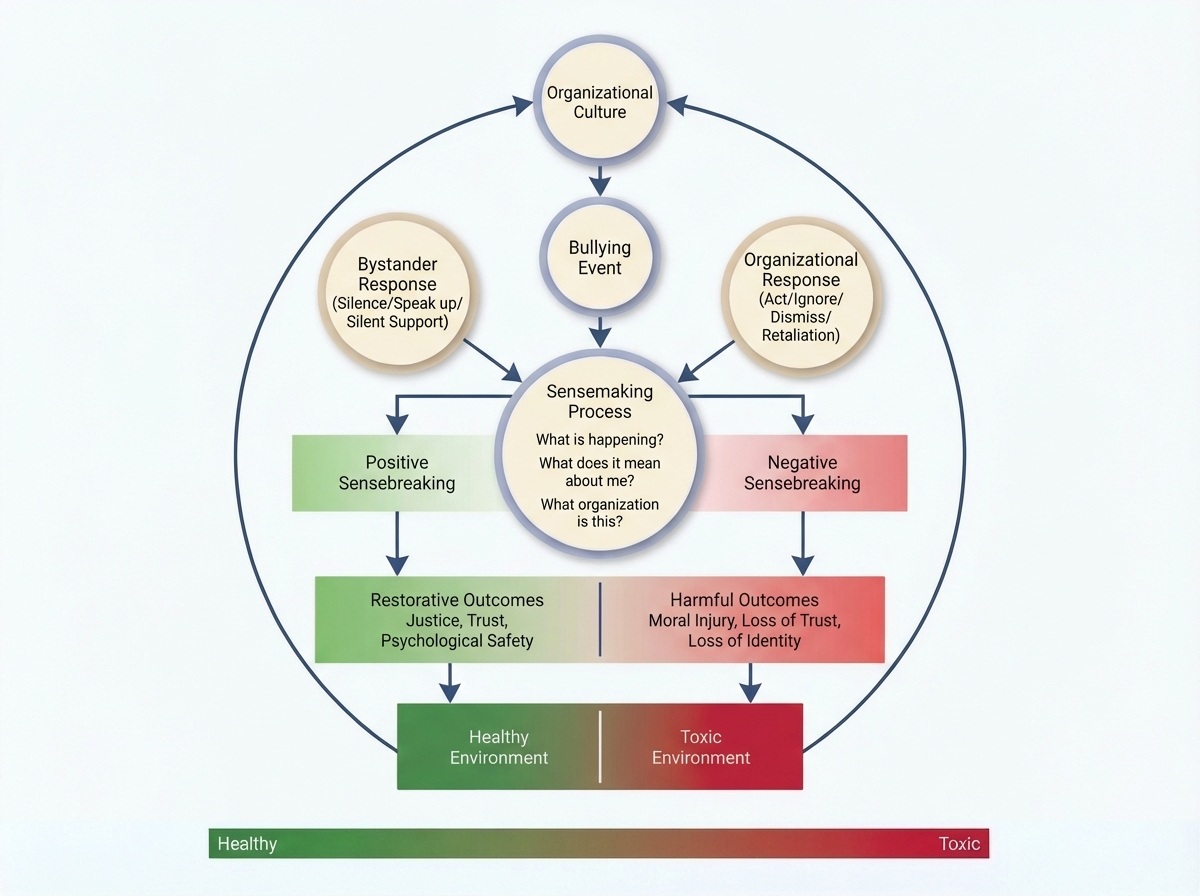
The Sensemaking Framework
This model illustrates how workplace bullying unfolds within organizational culture and how targets make sense of their experience. It reveals two interconnected dynamics: the sensemaking journey of the target and how organizational culture, organizational response, and bystander response shape that process.
Organizations engage in sensegiving—shaping how harm is interpreted and understood—and sensebreaking—when targets' expectations about fairness, protection, or justice are confirmed or shattered. Importantly, much of this sensegiving is unintentional and occurs through everyday interactions, silences, and contradictions between policy and practice.
When leaders instructed targets to "get along," reframed bullying as mutual conflict, enforced policies inconsistently, or prioritized institutional self-protection, they were not remaining neutral. Instead, they communicated powerful messages about whose experiences mattered, what kinds of harm were recognizable, and what risks accompanied speaking up.
The Sensemaking Model
Click on the model to view it in full screen.
Click the model to enlarge
Key Concepts in the Model
🏢 Organizational Culture
The shared values, norms, and practices that shape how people behave within an organization. Culture determines what is rewarded, what is tolerated, and what is punished.
Two cultural patterns emerged most consistently: authoritative, "yes-man," non-accountable leadership cultures, and clique-based, favoritism-driven cultures.
🔄 Sensegiving
How organizations actively shape how employees interpret their experiences. Through policies, leadership behavior, and cultural norms, organizations teach employees what is "normal" and acceptable.
💔 Sensebreaking
When an employee's fundamental assumptions about their workplace collapse—when expectations about fairness, protection, or justice are shattered rather than confirmed.
Many participants entered reporting processes believing that if they documented harm and followed procedures, the organization would respond with care. Instead, they encountered dismissal, normalization, or retaliation.
👥 Bystander Response
How colleagues respond when they witness bullying—through silence, speaking up, or silent support. Bystander responses send powerful messages about what is acceptable.
Participants described environments that implicitly communicated that someone had to be the target—and that safety came from not being that person.
🏛️ Organizational Response
How leadership, HR, and formal systems respond to reports of bullying—through action, dismissal, or retaliation. These responses shape whether targets experience positive or negative sensebreaking.
⚖️ Epistemic Injustice
Harms that occur when individuals are wronged specifically in their capacity as knowers—when their credibility is unfairly discounted (testimonial injustice) or they lack language to name their experience (hermeneutical injustice).
Participants repeatedly described being told their experience was a "personality conflict," "miscommunication," or simply "drama."
Key Takeaways
"A healthy workplace is not defined by the absence of harm, but by how people respond to it."
"You cannot always prevent the event, but you can prevent the damage."
"Every response you make is shaping your organization's future culture. Whatever happens next becomes the culture."
From the Research
This insight aligns closely with, and extends, the sensemaking framework developed by Adams, Scarduzio, and Redden (2025) in their study of sexual harassment reporting. Organizations engage in sensegiving—shaping how harm is interpreted and understood—and sensebreaking—when targets' expectations about fairness, protection, or justice are confirmed or shattered.
The deepest harm participants described did not stem from the bully alone, but from institutional abandonment and the silence of others. Being left alone—socially, emotionally, and professionally—produced what many described as moral injury: a profound rupture in trust, belonging, and faith in the organization.
Several participants said that the failure of leadership and the silence of others hurt more deeply than the bullying itself. Lack of support consistently surfaced as isolation, which participants described as one of the most devastating aspects of the experience. One participant reflected that being neither validated nor heard felt like having their "life force" drained.
Continue Your Journey
Explore the full research findings or discover what role you can play in creating healthier workplaces.